If you’ve spent any time around the campfire at any campsite, you’ve heard one debate come up again and again: travel trailers vs. fifth wheels. Okay, honestly, it’s usually less of a debate and more a topic of conversation with people looking to either upgrade their rig or move into their first RV. Especially when they run into someone who’s pulling the type of rig they’ve been considering.
Both are beloved—for good reason. Yet both also have their quirks, which make them better for some campers than others.
So, whether you’re shopping for your first rig (welcome!) or just thinking it’s time for a change (yay!), understanding the differences (beyond the hitch) can save you a lot of time and second-guessing.
The Basics: What’s the Difference Between Travel Trailers vs. Fifth Wheels?
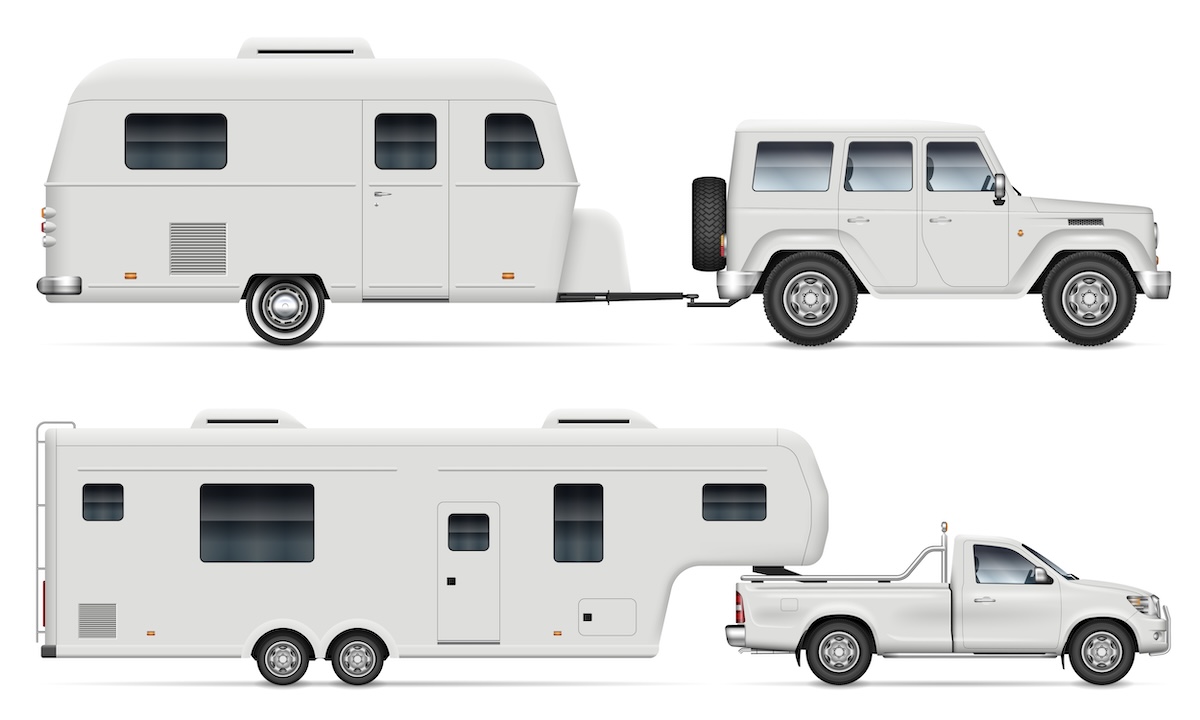
At the core level, it’s the hitch; i.e., how each one connects to your tow vehicle.
A travel trailer hitches to a standard ball mount on the back of your vehicle, which is typically called a bumper pull. The good news is that almost any capable truck, SUV, and even some larger crossovers can tow one—at least a smaller or lighter weight one. Making it a good choice for entry-level RVers who either don’t have a large truck or don’t want to purchase one.
A fifth wheel uses a specialized kingpin hitch mounted in the bed of a pickup truck, similar to those used by semi-trucks. That connection point is what gives the fifth wheel its name. It also promotes a more stable ride. You do, however, need a capable pickup truck to pull one.
While the two options come down to the same basic idea—a towable RV—they offer different experiences both on and off the road.

Travel Trailers: The Flexible, Friendly Option
Driving down the highway, you can quickly tell that travel trailers are the most popular type of RV. There are very good reasons for this, including:
- Affordability and Flexibility. These units tend to cost less than comparable fifth wheels, both in terms of upfront costs and tow-vehicle requirements. Because they use a standard ball hitch, they can be pulled by a wide range of vehicles—from trucks to SUVs to some crossovers. If you already own a capable vehicle, you may be good to go from the get-go. That can be a huge plus, as cars and trucks have dramatically increased in cost over the last several years—up more than 30% since 2020 and reaching record highs this year. Even used vehicles have seen a 2.8% increase in the last month alone.
- Size variety. Travel trailers come in a wide range of sizes—from lightweight teardrop trailers to full-sized 35-footers. With such an enormous range, you can find the right travel trailer for your family size (from solo campers to couples to large families) and camping preferences.
- Easy to park. Whether you’re returning home or just leaving your trailer as you explore the area, all you need to do is unhitch your vehicle and use it as usual.
While there are many positives, there are also a few drawbacks, such as:
- Sway. Without proper weight distribution and hitch control, travel trailers have a lot more sway—potentially fishtailing in crosswinds and when passed by large trucks. Many drivers have noted they spend a lot of time white-knuckling on both windy highway drives and winding through mountain passes. There are solutions to help make it much more manageable, but it is real and can be disquieting, especially as you get used to towing.
- Generally less interior space. Floor plans tend to be more linear and compact without a raised bedroom or living room area over the hitch. This is a plus for some RVers and a con for others.
- Lack of access while on the road. Unlike motorhomes, there’s no sneaking back for a quick coffee, snack, or bathroom break while on the road. (Truthfully, this is the same with a fifth wheel vs. a motorhome.)
Fifth Wheels: Roomier and Steadier
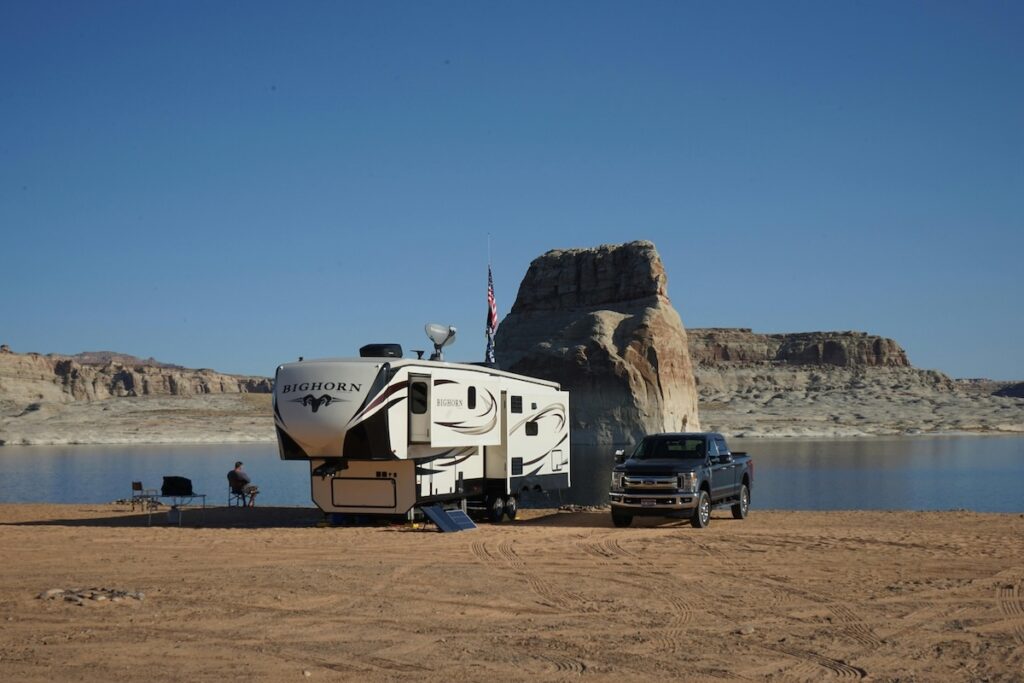
If you spend as much time around campsites and on RV forums as we do, you’ll find that fifth wheels have a devoted fan base, especially among full-timers and serious campers. Here’s why:
- Towing stability. The over-the-axle hitch connection dramatically reduces sway and makes towing feel much more controlled. Even after a long, windy day on the road or when navigating switchbacks, fifth-wheel drivers tend to pull into camp much more relaxed. Many drivers who have towed both types say it’s a night-and-day difference, and they wouldn’t go back.
- Greater living space. Because of the raised front section over the truck bed, these units offer split-level floor plans. Most offer a spacious bedroom up top and a full living area below. But some use that space for a surprisingly spacious living room instead. We’ve been in units that feel more like a house than an RV.
- Built for the long haul. If you are taking extended trips or living in the RV full-time (or just for the full season), fifth wheels typically offer more storage. While there are notable exceptions, they’re also built for longer hauls, more weather conditions (they’re more likely to be 4-season), with more amenities for greater comfort. That said, they also often come at a higher price point.
- Easier to tow and back in. Many RVers find that fifth wheels are more predictable and easier to maneuver into campsites than travel trailers.
Again, with the good come the tradeoffs, such as:
- You need a pickup truck. And not just any pickup truck will do. You typically need a three-quarter-ton or one-ton with the right tow rating. If you don’t already own one, that’s a significant added expense.
- The truck bed is occupied. Now that the hitch is in the bed, you have to rethink how to haul gear, bikes, and other cargo. That may require a toy hauler, hitch extender, or separate trailer.
- Higher cost. Fifth wheels tend to be more expensive. Not just to buy but also to insure.
Larger, taller campers can be harder to maneuver, especially in smaller or older campgrounds. No matter what type of rig you choose, bigger isn’t always better depending on where and how you travel.
Quick Comparison: Fifth Wheel vs. Travel Trailer
| Travel Trailer | Fifth Wheel | |
| Average Cost | Lower | Higher |
| Tow Vehicle | Truck, SUV, or capable crossover | ¾ Ton or 1- Ton pickup truck |
| Towing Stability | Good with proper setup | Excellent |
| Interior Space | Moderate | Spacious |
| Best for | Flexible campers, shorter hauls | Longer stays, full-timing, or full season |
| Maneuverability | Can be tricky | Generally easier |
A Word on Fuel Costs
Right now, gas prices are climbing and climbing fast. Many RVers are rethinking how (or how much) they’ll be traveling this summer. And if you’re on a budget, your tow vehicle’s fuel economy (or lack thereof) is likely top of mind. And it should be. It’s a real cost when camping. So, it’s important to be honest: towing anything hurts your mpg. A gas-powered half-ton truck that typically gets 20 mpg on the highway can drop to 10 – 13 mpg when pulling a loaded travel trailer. Heavier fifth wheels with a big diesel rig fare better in efficiency, but they cost more to fill up at the pump.
At the pump is where the choice of your tow vehicle matters as much as the trailer itself.
What About Electric Vehicles?
Electric vehicles now make up more than 20% of new cars sold worldwide (exceeding 17 million in 2024, with 1.6 million sold in the U.S.).
This has many drivers wondering if they can tow with an electric vehicle. The short answer is, of course, it depends. What are you towing and how far are you going?
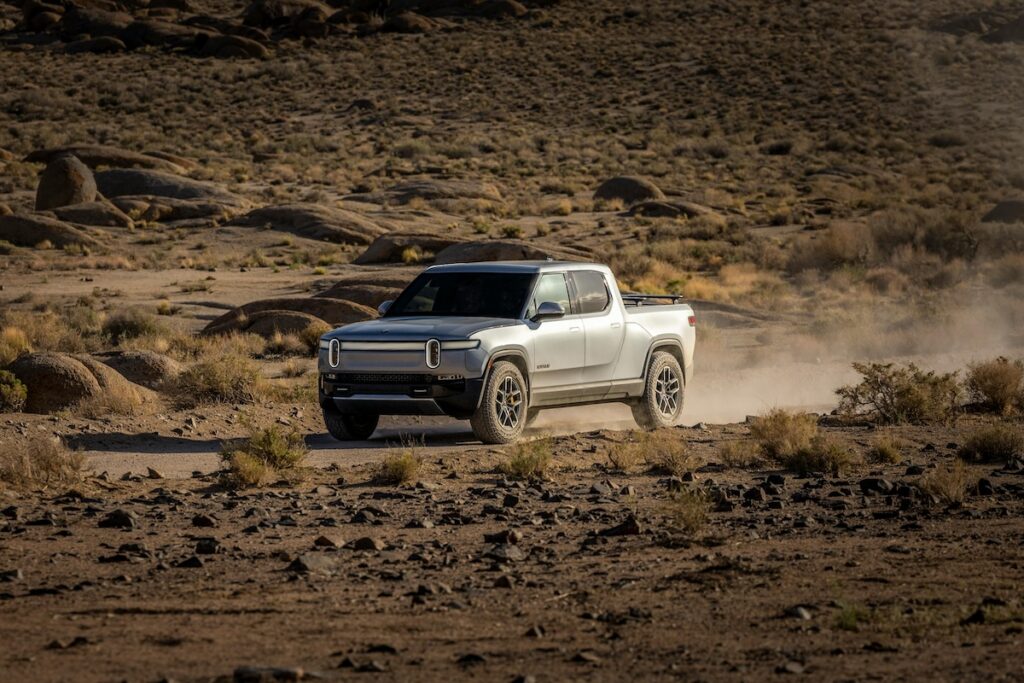
Several capable electric trucks, including the Ford F-150 Lightning, the Chevy Silverado EV, and Rivian RIT, have tow ratings that handle most travel trailers. Some electric SUVs, including the Tesla Model X (rated up to 5,000 pounds), can pull smaller, lightweight trailers as well.
Right now, the biggest catch is the range. Real-world tests consistently show that, much as it decreases the mpg for combustion engines, towing a travel trailer cuts the EV range by 30% to 50% or more. A truck rated at 300 miles may only be able to achieve 120 to 150 miles with a travel trailer attached. That means more frequent charging stops. And not every fast charger is easy to pull into with a trailer in tow. Some are downright impossible.
For shorter regional trips on well-traveled routes, an E-tow setup can absolutely work. And you’ll definitely save at the “pump.” But for long cross-country hauls to remote campgrounds, the charging logistics add serious route-planning challenges—at least for now.
A hybrid or plug-in hybrid truck, such as the Ford F-150 PowerBoost, Toyota Tundra i-FORCE Max, Ford Maverick Hybrid, Ram 1500 eTorque V-8, or Ram 1500 Ramcharger, may be a more practical middle ground right now as they offer better fuel economy without the range anxiety.
For fifth wheels, though, which require a full-size pickup, EV and even hybrid options are more limited. Most electric pickup trucks discuss hitch towing capacity, but the fifth-wheel towing capacity is rarely addressed. And the weight of a typical fifth wheel (often over 15,000 loaded) pushes the limits of what current electric trucks can handle. So, fifth wheel owners are, for the most part, sticking with gas or diesel vehicles. And diesels remain the dominant choice for heavy towing.
The bottom line: if fuel cost is a major factor in your decision, a lighter, smaller travel trailer paired with a more efficient tow vehicle gives you more options. Hopefully, eventually, we can see EV trucks that catch up to pull larger or heavier rigs.

What Matters Most: How You Love to Camp
Let’s be real here: there’s no universally “better” option. No matter which side is louder around the campfire. The right choice comes down to the one that best fits your camping life. Leaning toward a fifth wheel? Start with the best fifth wheel RVs Here’s a quick guide to see which one might suit you best:
| Your Camping Style | Better Fit |
| You’re a weekend warrior with an SUV or half-ton truck | ✅ Travel Trailer |
| You’re a full-timer or extended traveler | ✅ Fifth Wheel |
| You are a budget-conscious buyer | ✅ Travel Trailer |
| You puts comfort and space above all else | ✅ Fifth Wheel |
| You bring lots of gear | ✅ Travel Trailer |
| You already own a ¾-ton or 1-ton pickup | ✅ Fifth Wheel |
| You want flexibility to upgrade your tow vehicles later | ✅ Travel Trailer |
| You prefer a smoother tow experience | ✅ Fifth Wheel |
| You drive (or plan to drive) an EV or hybrid | ✅ Travel Trailer |
The Bottom Line
Travel trailers, fifth wheels, Class As, Class Cs, and vans can all take you to incredible places to create memories to last a lifetime. The “right” choice isn’t about what wins on paper. It’s about which one fits your travel style and budget—and that can change as your life changes. When you’re taking the family up to camp in a nearby state park, you may choose one type of rig. If you decide to travel the country and visit every National Park or every State Park—across the country with your partner, you may choose another option.
That said, if you’re newer to towing and want maximum flexibility, a travel trailer is a great way to start. Once you’re ready to go bigger, camp longer, or just want to give up the white knuckles, a fifth wheel might suit you better.
Whatever you choose, the road is waiting!