

Updated October 2026 from February 13, 2022
These quiet RV generators are portable power sources that keep the serenity up and the decibels down when you’re off-grid.
Look, we’ll just put it this way: you didn’t drag yourself across the map, negotiate the RV down that switchback, and park in your own pristine corner of nature to listen to the drone of BWAANNH. But if your generator isn’t designed for “do not disturb,” that’s exactly what you’ll hear—no matter how far out you go.
Luckily, you have better options. Whether it’s one of the quiet RV generators designed to keep the peace or the silence of solar power squeezing the juice out of the sun, you can lower the volume in the boondocks—without leaving all your wattage-powered comforts by the wayside.
Here’s how to do it with a quiet inverter generator, a portable solar kit, or our favorite—a little of both.
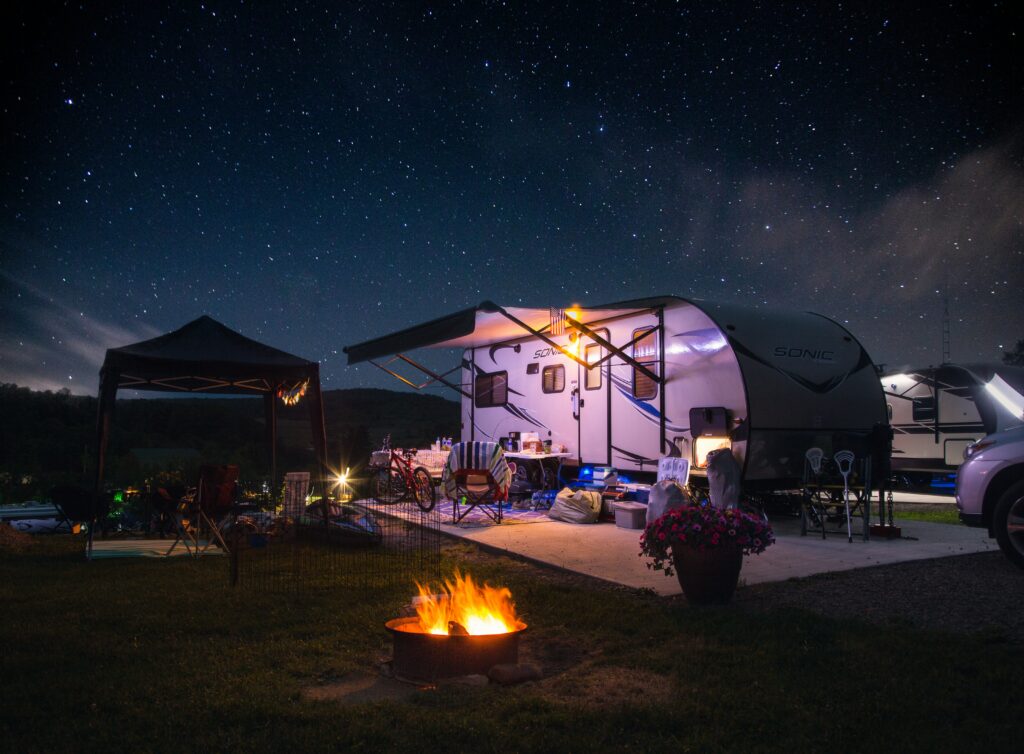
How Quiet Is a Quiet RV Generator?
The short answer? Most quiet RV generators run at about 50 to 60 decibels (dBA). That’s at or below the level of a normal conversation. In comparison, an open-frame contractor generator often runs at 70 dBA or louder. And because every 10 dBA sounds roughly twice as loud, that difference is a big deal when you’re in a hopefully peaceful campground.
Before you start comparing spec sheets, it’s worth knowing that manufacturers usually measure noise from about 23 feet away, often at a light (quarter) load. If you run the generator hard, it gets louder than advertised. That’s a good reason to size it right.

Size Down to the Essentials
Being off-grid is about stripping things down to their essentials. (See ya, constant AC.) So, while you could opt for a larger, louder, more powerful generator, we recommend you don’t.
Instead, calculate the wattage of the items you need to power while roughing it. When you get down to the basics (running appliances, charging phones), you’ll find you can likely manage nicely under 2000 watts while primitive camping.
Check the label or owner’s manual on each appliance for its running watts. And then leave a cushion for anything with a motor or compressor since those draw a short burst of extra power when they start up. The big exception is your rooftop air conditioner, which we’ll get to in a minute.

Gas Power, Without the Growl
Harnessing the ever-ready and user-friendly muscle of gas, portable inverter generators are a go-to for RVErs who want power without the racket. Unlike old-school generators that roar along at full speed no matter what, an inverter generator throttles its engine up and down to match what you’re actually using. Less work means less noise, and the inverter’s clean power is safe for phones, laptops, and your rig’s electronics.
Two longtime favorites from our original roundup are still going strong: The HONDA EU2200i (dBA 48 to 57) and CHAMPION Ultralight (dBA 53). Both are easy to store and pretty easy to carry. Best of all, they run quieter than a normal conversation, freeing you to take in the delicate sounds of nature around you.
Honda EU2200i 2200-Watt Super Quiet

Honda EU2200i
If you’ve spent any time on RV forums, you’ve seen the EU2200i come up again and again. Honda’s reputation for reliability and quiet operation is the reason so many campers consider it the benchmark. It puts out 2,200 watts (1,800 running), weighs 51 pounds, and runs up to 8 hours on less than a gallon of gas, as long as the load is light.
Newer versions add Honda’s CO-MINDER carbon monoxide shutoff and Bluetooth app control. Need more power? Pair two with a parallel cable for up to 4,400 watts.
Honda EU3200i
If you want one Honda that can handle the AC, this is it. The EU3200i is Honda’s lightest, most compact 3,000-watt-class generator, and Honda rates it to run a 13,500 BTU rooftop AC unit, plus the fridge, furnace, and microwave.
It stays impressively quiet at 54 – 58 dBA. A fuel-injected engine means easier starts with no choke, and it runs up to 8.6 hours on a tank at light load. Like its smaller sibling, it offers CO-MINDER and smartphone control through Honda’s My Generator app.
Caveat: At over 60 pounds, it’s a two-hand lift, and it costs roughly 2.5x the EU2200i.
Champion 2500-Watt Dual Fuel Inverter
Champion has replaced the 2,000-watt Ultralight from our original roundup with the 2,500-Watt Dual Fuel Inverter, and it’s an upgrade. More power with the same quiet 53 dBA rating. On gas, it delivers 2,500 starting watts and 1,850 running watts and runs up to 25 hours on a tank at light load.
If you’d rather skip the gas cans, it also runs on propane, a handy option since most RVers already carry propane on their adventures. It weighs 43.2 pounds, includes Champion’s CO Shield carbon monoxide auto shutoff, and costs a fraction of what the Hondas do.
Two Small Generators Beat One Big One
Most quiet inverter generators are “parallel ready.” Link two matching 2,000-watt units with a parallel kit, and you get enough power for a 30-amp RV. Two 40-pound generators are a lot easier to lift than one 100-pound unit, and on mild days, you can bring (or use) just one.
Can a 2,000-Watt Generator Run Your RV AC?

Often, yes—as long as they get a little help. A rooftop AC typically uses under 1,900 watts once it’s running. The trouble is the jolt of power it pulls for a split second when the compressor kicks on. That surge is why AC makers usually recommend a 4,000-watt or larger generator and why a small generator often trips the moment the AC starts.
A soft starter fixes that. The Micro-Air EasyStart 364 mounts inside your rooftop unit and, according to the company, cuts that startup surge by 60 to 70%. Plenty of RVers report starting a 13,500 BTU AC on a single 2,000-watt generator after installing one.
A few tips: the EasyStart needs five “learning” starts after installation, and it works best when the AC is the only big load on the generator. Heat and high altitude also cut into the generator’s output, so results vary.
If your AC isn’t keeping up once it’s running, we’ve got you covered here: RV AC Isn’t Blowing Cold Air?
Solar, the Power of Silence
Not everyone is able to strip down their noise signature to nothing because not everyone has solar. If you’re happy to be not everyone, you can power a superlight footprint with portable units like the DuraLite 100-watt Solar Kit from GoPower! Easy to store and a setup that takes minutes, the 10-pound solar kit comes with a 30-amp charge controller, cables, and everything you need to charge your battery.
The newest version of the kit works with lithium batteries and plugs straight into the Zamp Solar Ready and Go Power! Sidewall ports found on many newer RVs, and expands to 300 watts with up to two add-on panels.
Caveats: 100 watts of solar keeps your batteries topped off for lights, fans, phones, and the water pump, but it won’t run high-draw appliances on its own. For that, many RVers now pair panels with a portable power station.

The Quietest Setup Uses Both
For many boondockers, the sweet spot isn’t RV generator vs. solar. It’s both. Let the panels quietly top off your batteries all day, and save the generator for cloudy stretches, cooling off on a hot afternoon with the AC pumping, or a quick recharge. Instead of the all-day drone, it runs for an hour or two, and the rest of the day, you hear nothing at all.
Powered by nature itself, a solar kit frees you to hear nature just as it sounds, to experience it just as it is. Which is, after all, the whole reason you’re out there.
| Product | Weight | Watts | Noise | Run time (¼ load) |
| Honda EU2200i | 51 lb | 2,200 | 48 – 57 dBA | 8.1 hr |
| Honda EU3200i | 66.1 lb | 3,200 | 54 – 58 dBA | 8.6 hr |
| Champion 2,500 Ultralight | 44 lb | 2,500 | 53 dBA | 25 hr |
| Go Power! DuraLite 100W Kit | 8.5 lb | 100 W solar | Silent | n/a |
